Did Roku's founder get rich? About $1.54B in cash, and he gave up 55% of the votes for it

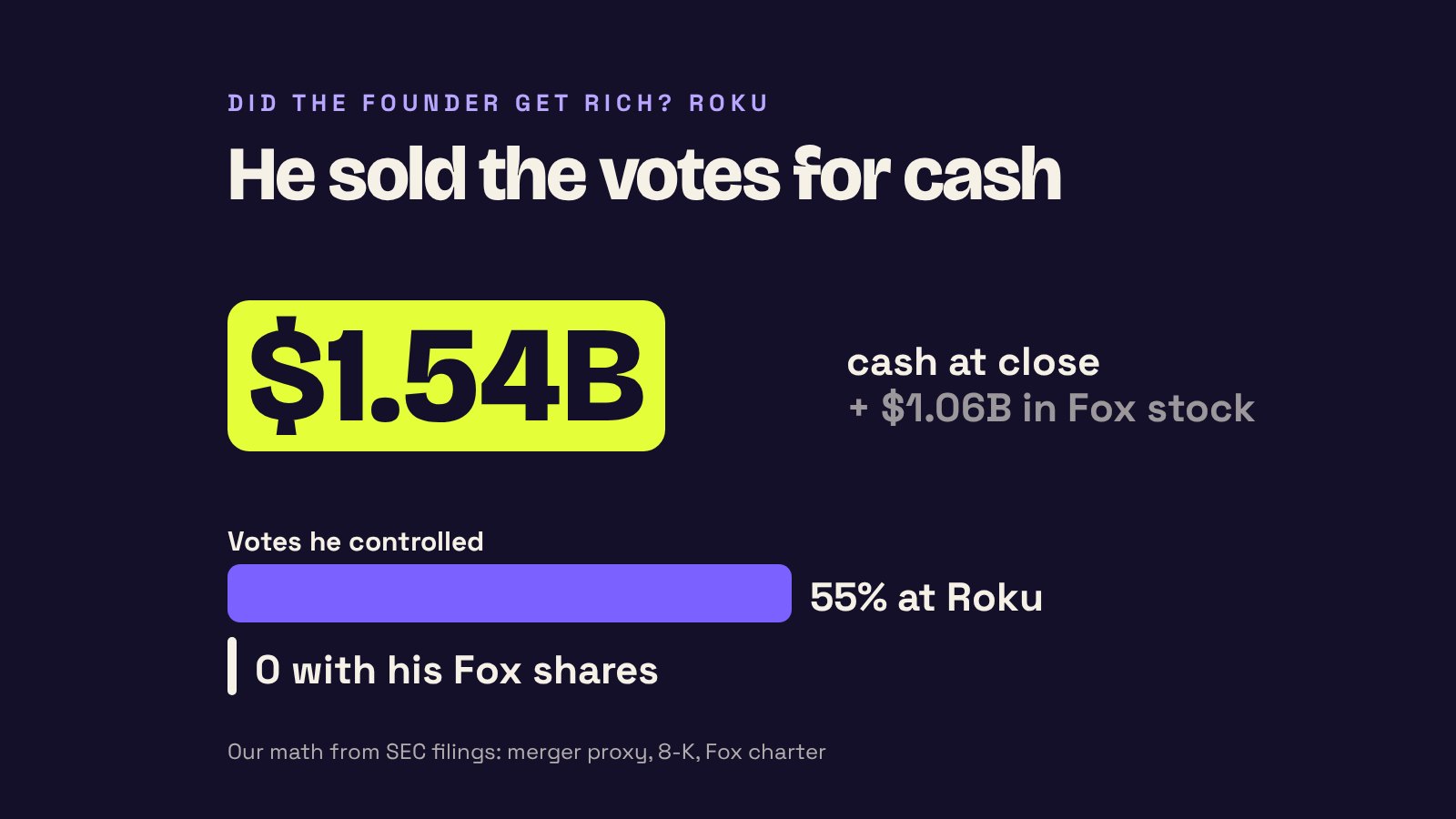
Short answer: Did Roku's founder get rich? Yes, in cash, and he already was. Fox closed its $22 billion acquisition of Roku on November 6, 2026, months ahead of plan (TechCrunch). Each Roku share became $95.30 in cash plus 0.9799 of a Fox Class A share (SEC 8-K). Anthony Wood, who founded Roku in 2002, held about 16.17 million shares through his trusts (merger proxy). By our math that is about $1.54 billion in cash and about 15.8 million Fox shares, worth roughly $1.06 billion. The twist: Fox Class A stock "has no right to vote" (Fox charter, SEC). The founder who controlled Roku now owns a big piece of a company the Murdochs control.
Every headline about Fox buying Roku is about TV. Ours is about one man: Anthony Wood held about 11% of Roku's shares and 55% of its votes. On November 6 he turned that into roughly $1.54 billion in cash and about $1.06 billion in Fox stock that has no vote. Here is the math, with sources.
The 30-second version
Did Roku's founder get rich? Yes, in cash, and he already was. Fox closed its $22 billion acquisition of Roku on November 6, 2026, months ahead of plan (TechCrunch). Each Roku share became $95.30 in cash plus 0.9799 of a Fox Class A share (SEC 8-K). Anthony Wood, who founded Roku in 2002, held about 16.17 million shares through his trusts (merger proxy). By our math that is about $1.54 billion in cash and about 15.8 million Fox shares, worth roughly $1.06 billion. The twist: Fox Class A stock "has no right to vote" (Fox charter, SEC). The founder who controlled Roku now owns a big piece of a company the Murdochs control.
Headline price: $160 per share, about $22B enterprise value (agreed June 15, 2026, closed November 6, 2026).
Founder stake: 16,150,111 Class B + 20,181 Class A shares, about 10.9% of the 148.5M shares, but 55.1% of the voting power (merger proxy). Options and stock awards not counted.
Cash at close: about $1.54B (16.17M x $95.30). Stock: about 15.8M non-voting Fox Class A shares, about $1.06B at the November 6 close. No earnout, no holdback for shareholders.
Next role: Fox board member and co-chair of Fox Digital Platforms, for up to two years, at pay "equal to or less than" his Roku pay (proxy).
Years it took: 24 years from founding (2002) to the sale. Roku was his sixth company.
Verdict: LIFE-CHANGING, mostly in cash. The price of that cash: he gave up control.
The timeline
| When | What happened | What it meant for the founder |
|---|---|---|
| 1997-2001 | Wood builds ReplayTV, one of the first DVRs, then sells it to SONICblue in 2001 (Texas A&M). | "Not a great outcome," in his own words. |
| 2002 | He founds Roku, his sixth startup; roku means "six" in Japanese (Texas A&M). | Starts over, with the DVR lesson in hand. |
| 2017-2026 | Roku is public with two share classes: Class B carries ten votes per share. Wood holds 98.7% of Class B (proxy). | Control of the company, with about 11% of the shares. |
| June 15, 2026 | Fox agrees to buy Roku for $160 per share: $96 cash + 0.9693 Fox shares. Wood's trusts sign a support agreement covering a majority of the votes (Fox). | His signature alone decides the vote. |
| Nov 6, 2026 | The deal closes early. Some shareholders sought appraisal, so the mix shifts to $95.30 cash + 0.9799 shares (SEC 8-K, StockTitan). | About $11M of his cash becomes Fox stock instead. |
In his own words
We haven't found an interview where Wood talks about his own payout from the Fox deal, so we won't guess what he thinks of it.
Three lessons for any app founder
What happened: with about 11% of the shares, Wood held 55% of the votes. The sale happened because he agreed to it, on his timing.
Lesson: most app founders give up control in their first rounds without noticing. Votes, board seats and veto rights decide who chooses when, and to whom, you sell.
What happened: when about 1% of shareholders asked a court to value their shares, a clause in the deal moved $0.70 per share from cash to stock. For Wood, that is about $11M less cash.
Lesson: the headline price can stay the same while your cash changes. Ask what can shift the cash/stock mix before you sign.
What happened: about 40% of Wood's payout is Fox stock with no vote. Its value now depends on decisions made by Fox's controlling shareholders.
Lesson: cash at close is yours. Buyer stock is a bet on someone else's company. Price it like one.
What we'd tell a founder in their shoes
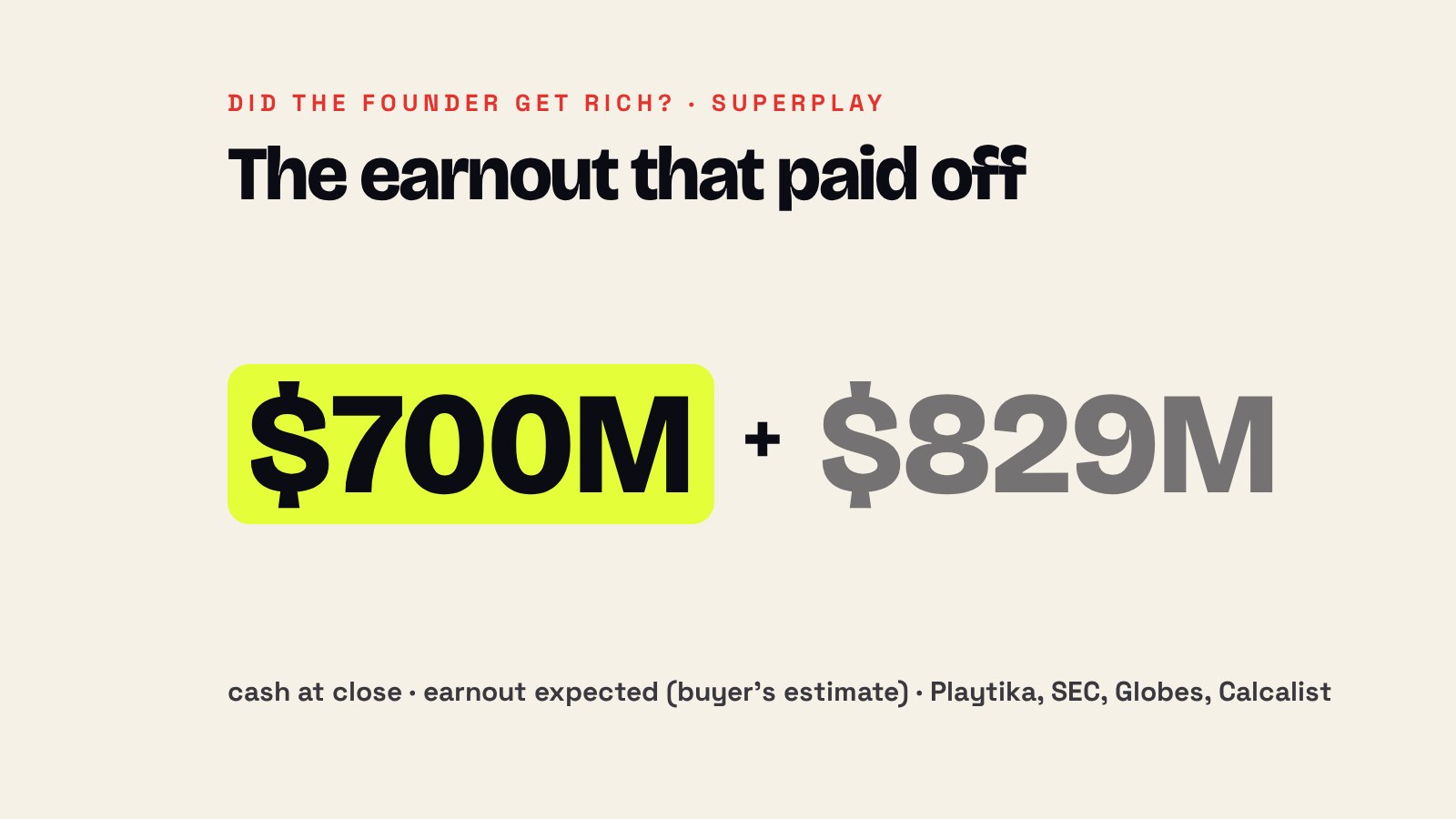
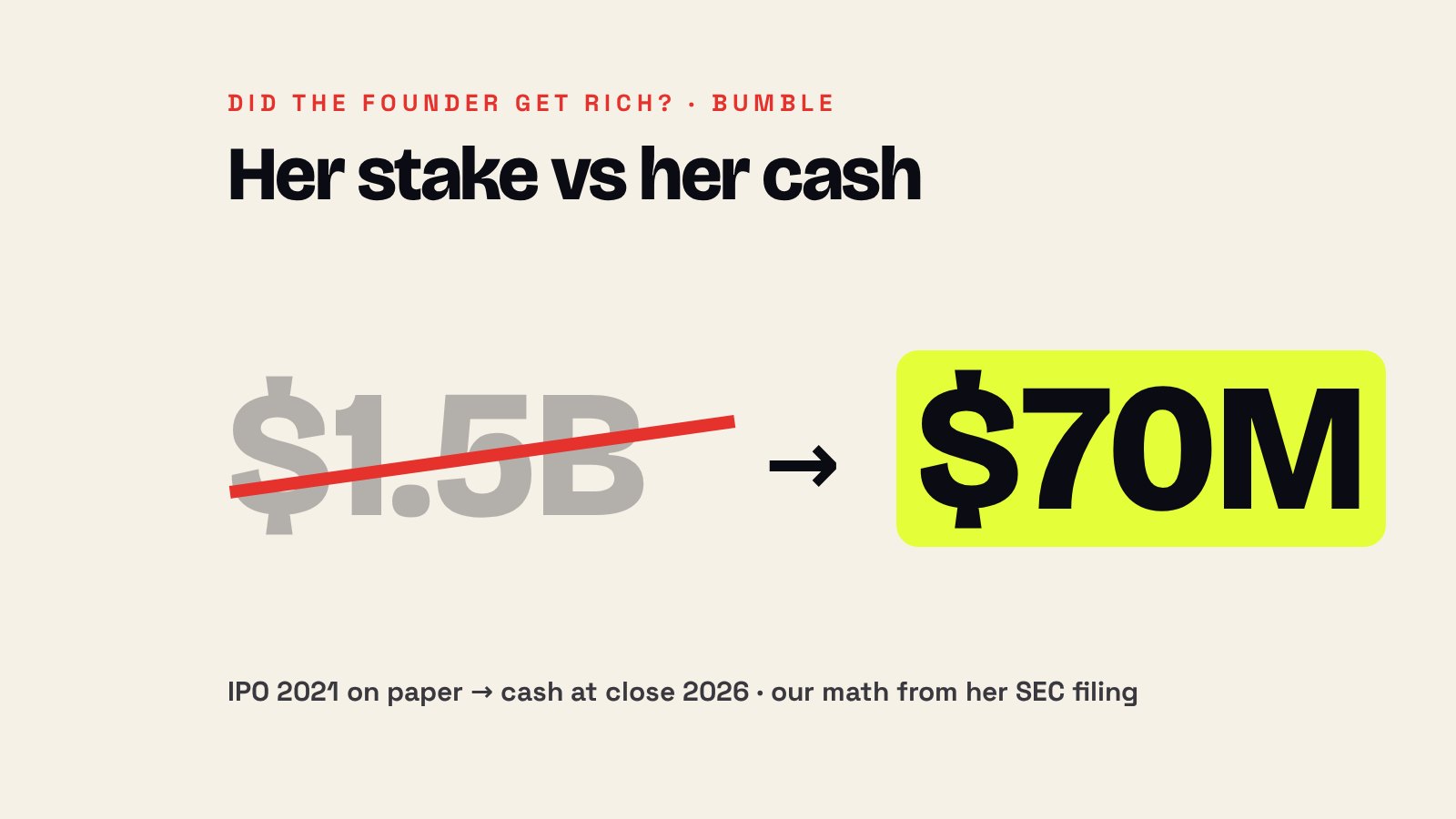
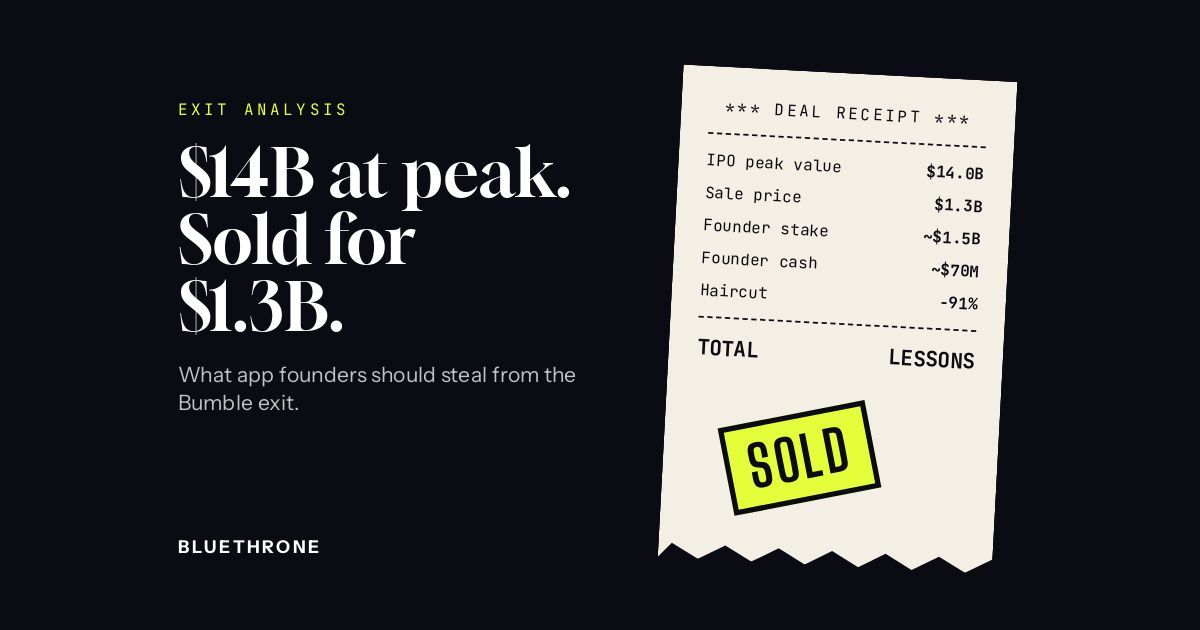
Wood got the rare outcome: he kept control for 24 years, then sold it for a price where most of what he took home was cash. Most app founders never get there, because the control leaks out round by round, and by the time an offer arrives, someone else decides. When an offer comes, look past the headline: how much cash lands at close, what can change that number, and who decides what your stock is worth after. Check what your app is worth, or read how to sell your app to a company. More founder stories: Bumble and SuperPlay.
FAQ
Did Roku's founder get rich from the Fox deal?
Yes. By our math from SEC filings, Anthony Wood's roughly 16.17 million shares turned into about $1.54 billion in cash and about 15.8 million Fox Class A shares, worth about $1.06 billion at the November 6, 2026 close.
How much did Fox pay for Roku?
About $22 billion in enterprise value, or $160 per share. At closing, each Roku share became $95.30 in cash plus 0.9799 of a Fox Class A share.
Why did the Roku deal terms change at closing?
The merger agreement shifts part of the cash into stock if about 1% or more of shares seek appraisal. The final mix moved from $96.00 cash and 0.9693 shares to $95.30 cash and 0.9799 shares.
Did Anthony Wood control Roku?
Yes. He held 98.7% of Roku's Class B shares, which carry ten votes each, giving him 55.1% of the voting power with about 11% of the shares.
What is Anthony Wood's role after the sale?
He joined the Fox board and serves as co-chair of Fox Digital Platforms, for up to two years, with pay equal to or less than his pay at Roku, according to the merger proxy.
Written by Idan Waller, co-founder of BlueThrone. Part of our series "Did the founder get rich?": we judge every exit by one question, how much the founder took home in cash.


Keep reading








Time for
your exit?