DoorDash buys Instacart for $17B: did the founder get rich? Exit analysis for app founders

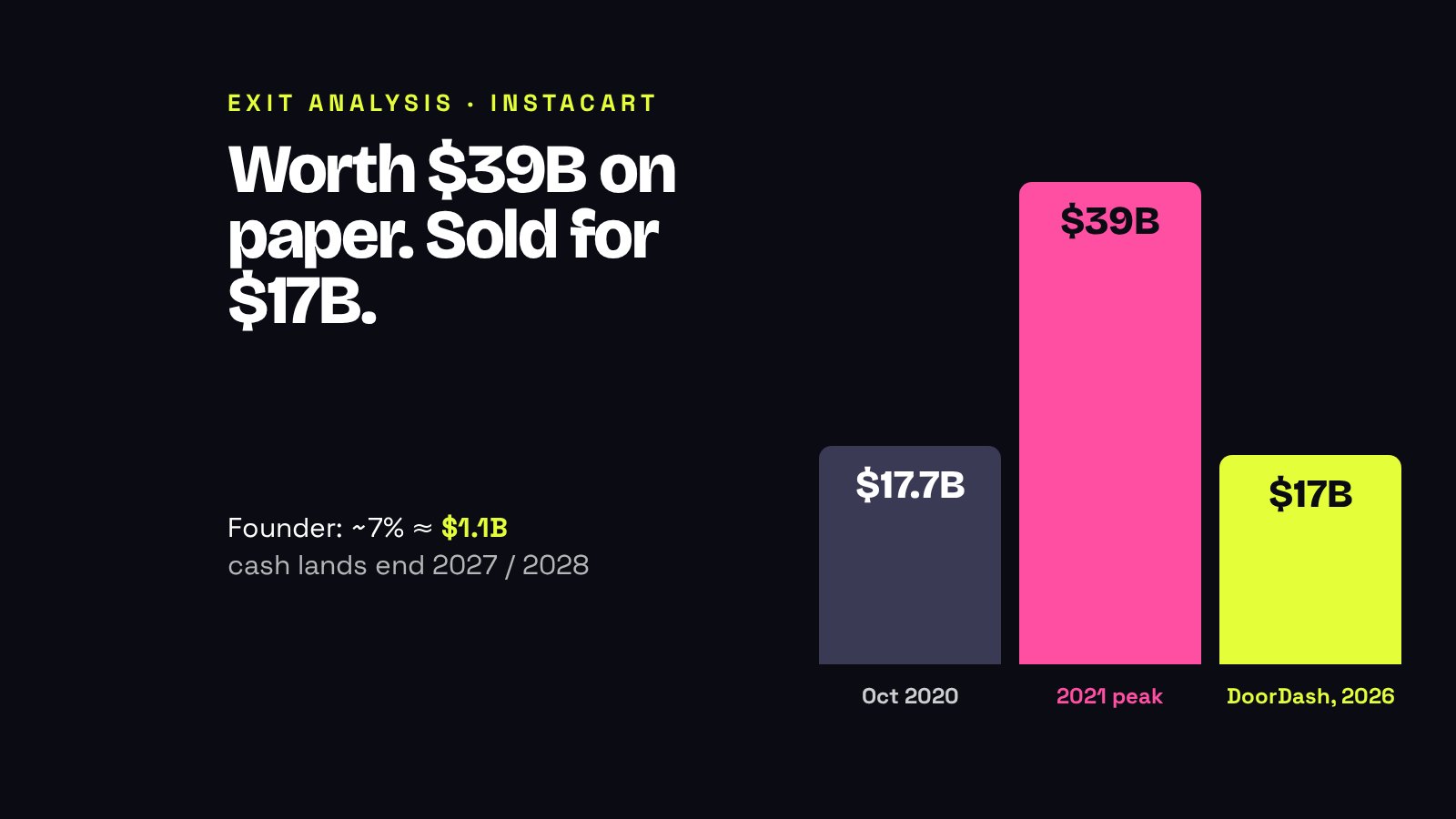
Short answer: On October 29, 2026, DoorDash agreed to acquire Instacart (Maplebear Inc.) for $65.00 per share, about $17 billion, paid in at least 75% cash and up to 25% DoorDash stock. That is a 26% premium to Instacart's close on October 22, the last day before the deal was reported. Closing is expected at the end of 2027 or first half of 2028, pending shareholders and regulators in the US, Canada and Israel (DoorDash 8-K press release, CNBC). Founder Apoorva Mehta held about 7% (roughly 17 million shares) per the April 2026 proxy (Forbes): about $1.1B at $65 if he still holds them.
DoorDash is buying Instacart for about $17 billion. That is almost exactly what Instacart was worth in October 2020, and less than half of its 2021 peak. And the founder? He still walks away a billionaire, but the cash only lands at the end of 2027 at the earliest.
The 30-second version
On October 29, 2026, DoorDash agreed to acquire Instacart (Maplebear Inc.) for $65.00 per share, about $17 billion, paid in at least 75% cash and up to 25% DoorDash stock. That is a 26% premium to Instacart's close on October 22, the last day before the deal was reported. Closing is expected at the end of 2027 or first half of 2028, pending shareholders and regulators in the US, Canada and Israel (DoorDash 8-K press release, CNBC). Founder Apoorva Mehta held about 7% (roughly 17 million shares) per the April 2026 proxy (Forbes): about $1.1B at $65 if he still holds them.
Stake: about 7%, roughly 17 million shares, per the April 2026 proxy as reported by Forbes. Forbes notes he may have sold some since (Forbes).
Value at the deal price: about $1.1B (our estimate: 17M shares x $65.00, if he still holds them all).
Cash already taken: at the 2023 IPO he sold about 700,000 shares at $30, roughly $21M (Forbes, 2023).
Cash vs stock at close: shareholders can elect cash, DoorDash stock or a mix; overall at least 75% cash, stock capped at 25%.
Years it took: founded 2012, closing end of 2027 or H1 2028: about 15 to 16 years.
Verdict: life-changing. A billionaire on paper again, with most of it payable in cash. But it is a fraction of what the 2021 paper value suggested, and the cash is still more than a year away.
The founder's story: 20 failed startups, then groceries
Apoorva Mehta grew up in a small town near Toronto, after his family moved to Canada when he was a teenager. He studied electrical engineering at the University of Waterloo and became a supply-chain (logistics) engineer at Amazon (Wikipedia). In his own words, the idea started long before the company:
He left Amazon in 2010 and spent two years building about 20 minimum viable products in enterprise, consumer and advertising. Every one of them failed (Y Combinator Q&A). One was an ad network for social gaming companies; another was a social network for lawyers he worked on for a whole year (Gulf News). He founded Instacart in 2012 at 26, got into Y Combinator by delivering a six-pack of beer to a partner through the app, and met co-founders Max Mullen and Brandon Leonardo there. He handed the CEO role to Fidji Simo in July 2021, became executive chairman, and left entirely when the company went public in September 2023 (Wikipedia). Today he runs a new health startup, Cloud Health Systems.
He is not a bitter ex-founder on the sidelines. On deal day he said he and DoorDash CEO Tony Xu had discussed combining the companies for years:
The lessons he published himself
These are Mehta's own words from his interviews, not our summary of "what he must have thought".
Hear it from him: Apoorva Mehta on the start-up lessons he learned the hard way (2015 CEO Summit, Conscious Capitalism).
1. Build something you care about. On the lawyers' network: "I realised it wasn't that I couldn't find a product that worked, I just didn't care about the product... I didn't care about lawyers." (Gulf News)
2. A failed idea can be a timing problem. Webvan had famously died on grocery delivery. Mehta: "It was very clear to me that the idea was a good one and the time was now," because smartphones made it work, as they did for Uber and Lyft (Gulf News).
3. Use what exists instead of rebuilding it. Competitors built warehouses and trucks; Instacart used the roughly 30,000 US grocery stores and crowdsourced the delivery, and "today Amazon, Walmart and Target are replicating our model" (Y Combinator Q&A).
4. Stay paranoid, on purpose. "I'm perpetually paranoid that something will get in the way... I use this feeling to motivate myself to ask hard questions about our strategy" (Y Combinator Q&A).
5. Be a learning machine. "Great founders are learning machines... go out of your way to learn, from books, from people and from experiences" (Y Combinator Q&A).
6. Don't start a company to have a company. "The reason to start a company is to bring a change that you strongly believe in to this world. You really have to want to do this." (Gulf News)
Our read for app founders: lessons 1 and 3 are why Instacart got bought. A founder who cared about one boring problem (groceries) built on top of an asset that already existed (stores). That made it worth $17B to the one buyer that needed it most. The 20 failures before it weren't wasted: they were his training.
The price chart a founder should stare at
Instacart was valued at $17.7B in October 2020 and $39B in March 2021 (TechCrunch). It went public in 2023 at $30 a share. Six years after that 2020 round, a strategic buyer is paying about $17B: almost exactly the 2020 number, in a company that kept growing in between.
| When | What | Value |
|---|---|---|
| Oct 2020 | Private round | $17.7B |
| Mar 2021 | Private round (peak) | $39B |
| Sep 2023 | IPO | $30 per share |
| Oct 22, 2026 | Close before reports | $51.68 per share |
| Oct 29, 2026 | DoorDash offer | $65.00 per share, ~$17B |
Our take: the 2021 $39B was a price on paper that nobody could cash out at. For a founder, a valuation only counts on the day someone pays it in cash. Mehta's stake looked like several billion in 2021; the number he can actually collect is about $1.1B, and only after regulators sign off.
The part nobody writes about: when the cash actually lands
The deal was announced in October 2026, but closing is expected at the end of 2027 or the first half of 2028. It needs Instacart shareholders, the US Hart-Scott-Rodino waiting period, and approvals in Canada and Israel (DoorDash 8-K press release). DoorDash has lined up a bridge loan of up to $13B to pay the cash part. Until closing, the founder's outcome is a promise, not money in the bank.
Mehta has one advantage most app founders don't: Instacart is public, so he could sell shares on the market before closing if he wanted. For a private app, there is no market. The deal is the liquidity, so the time from signed term sheet to cash in your account matters as much as the price.
1. Paper value is not your number. The $39B was a round price, not an exit. Know what a buyer would pay in cash today: that is your real number.
2. Ask "when is the cash in my account?" Here: 14 to 20 months after the announcement. For small app deals, regulators are rarely an issue, so push for a short close.
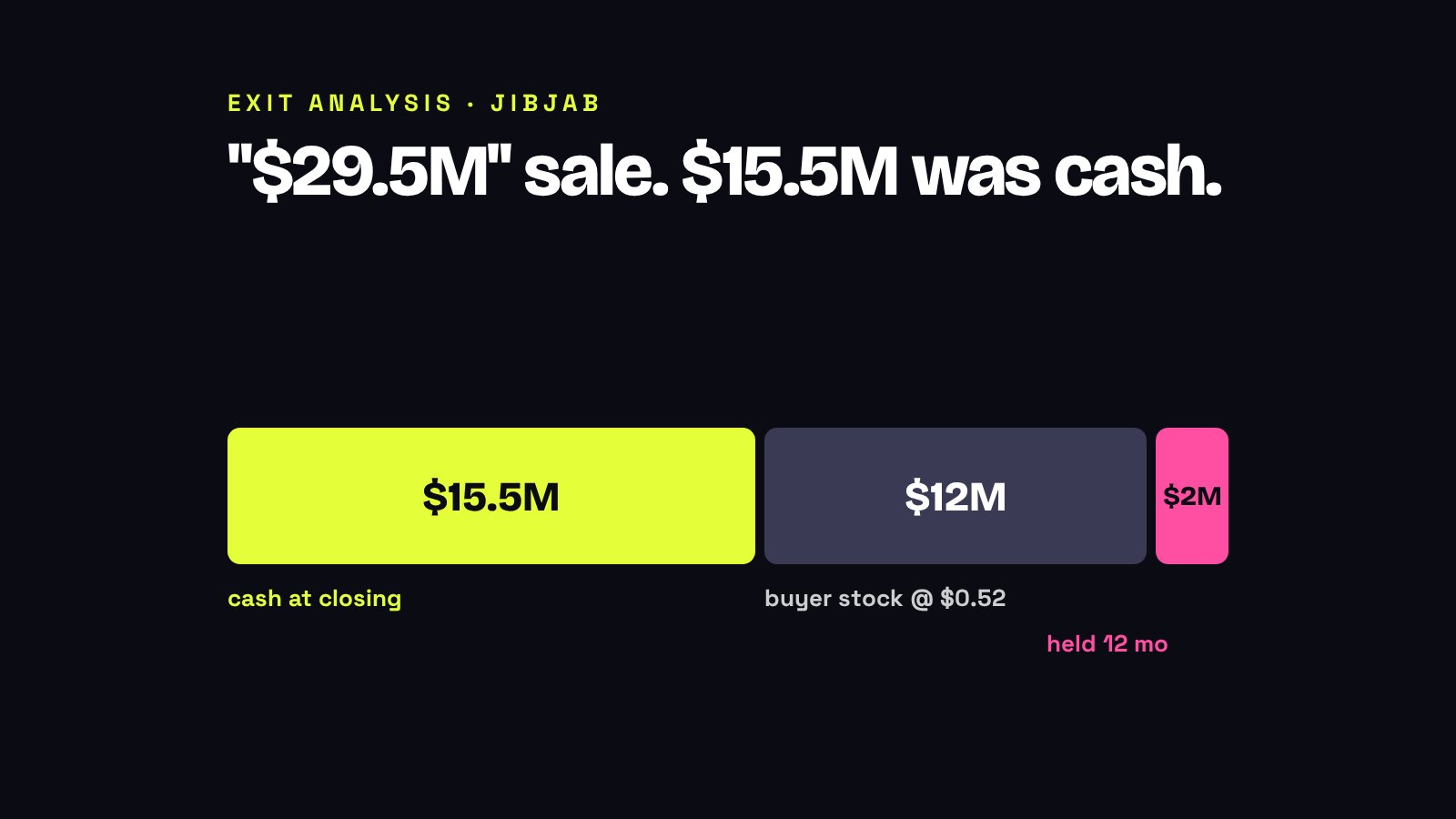
3. Read the cash-vs-stock split. Here: at least 75% cash. In smaller deals, stock in a private buyer can be worth much less than its headline value (see our JibJab analysis).
4. Selling to a strategic is often the best price. DoorDash pays a premium because it can merge memberships and logistics. Find the buyer who can do more with your users than you can.
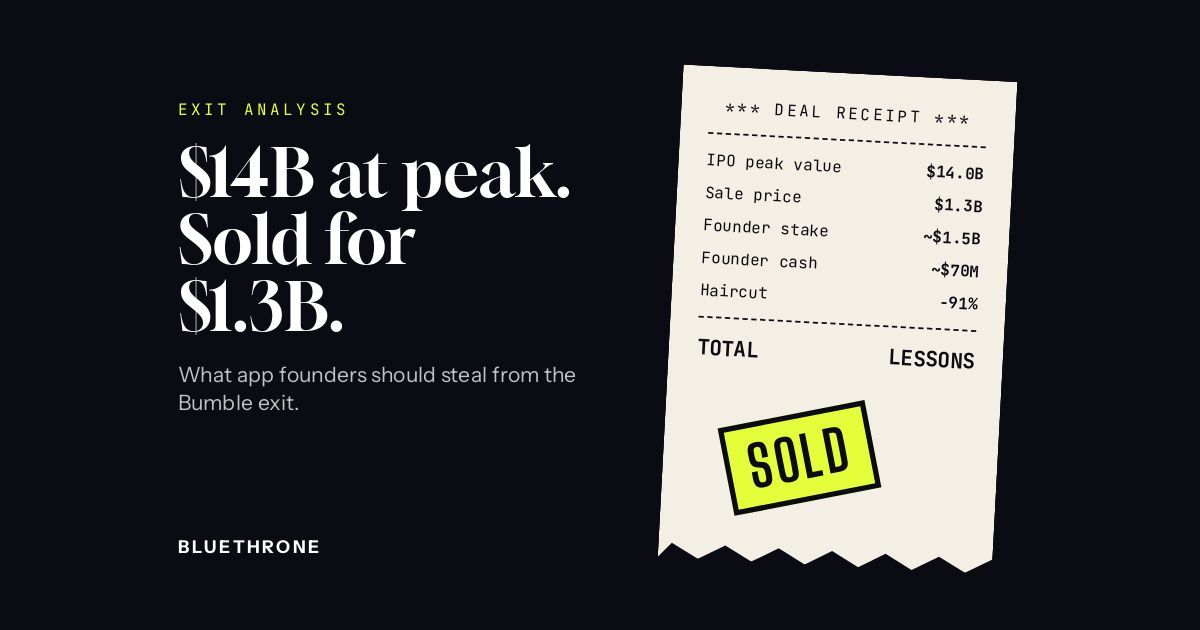
Want to know what your app is worth in cash, today? Run it through our free valuation calculator, then read how to sell your app to a company. For another big-name deal read from the founder's side, see our Bumble exit analysis.
FAQ
How much is DoorDash paying for Instacart?
$65.00 per Instacart share, about $17 billion in total, announced on October 29, 2026. At least 75% is paid in cash and up to 25% in DoorDash stock.
When will the DoorDash-Instacart deal close?
DoorDash expects closing at the end of 2027 or in the first half of 2028, subject to Instacart shareholder approval, the US Hart-Scott-Rodino waiting period and regulatory approvals including in Canada and Israel.
Did the Instacart founder get rich?
Yes. Apoorva Mehta held about 7% (roughly 17 million shares) per the April 2026 proxy, as reported by Forbes. At $65 a share that is about $1.1 billion, our estimate, if he still holds all of them. He also sold about 700,000 shares at the 2023 IPO.
Is $17 billion more than Instacart was worth before?
It is about the same as its October 2020 private valuation of $17.7 billion, and less than half of its $39 billion valuation in March 2021.
What did Apoorva Mehta do before Instacart?
He was a supply-chain engineer at Amazon. After leaving in 2010 he spent two years building about 20 minimum viable products that all failed, including an ad network for social gaming companies and a social network for lawyers, before founding Instacart in 2012.
What should app founders learn from the Instacart deal?
Judge your outcome by the cash you can actually collect and when, not by your highest paper valuation. Check the cash-versus-stock split and the time to closing.
Written by Idan Waller, co-founder of BlueThrone. We buy and grow mobile apps, so we read every deal from the founder's side of the table.


Keep reading







Time for
your exit?