App Exit Multiples 2026: What Apps Actually Sell For, by Business Model

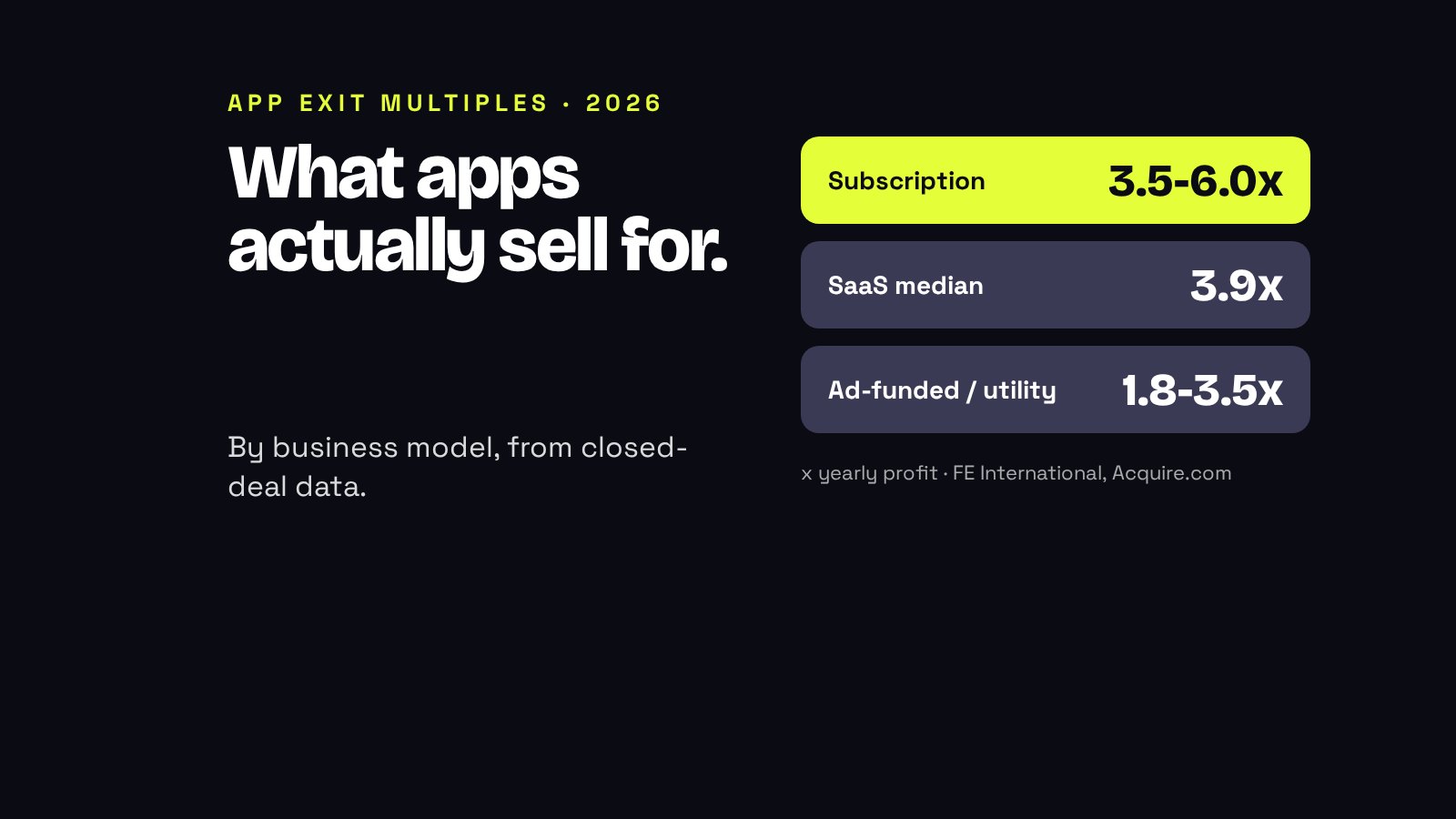
Short answer: Most small and mid-sized apps in 2026 sell for about 2x to 6x yearly profit, not a multiple of revenue or downloads. Subscription apps with real retention sit highest at 3.5x to 6.0x adjusted earnings, ad-funded and single-platform utility apps at 1.8x to 3.5x (FE International, 1,500+ closed deals). Profitable SaaS sold at a 3.9x median profit multiple in both 2024 and 2025 (Acquire.com, Jan 2026 report). Revenue multiples only apply when growth is above about 20% a year with gross margins above 70%.
Every marketplace publishes a range. Read them side by side and one thing jumps out: two apps of the same size and the same model can sell for multiples twice apart. The business model sets the band. What you do inside it sets the price.
The 30-second version
Most small and mid-sized apps in 2026 sell for about 2x to 6x yearly profit, not a multiple of revenue or downloads. Subscription apps with real retention sit highest at 3.5x to 6.0x adjusted earnings, ad-funded and single-platform utility apps at 1.8x to 3.5x (FE International, 1,500+ closed deals). Profitable SaaS sold at a 3.9x median profit multiple in both 2024 and 2025 (Acquire.com, Jan 2026 report). Revenue multiples only apply when growth is above about 20% a year with gross margins above 70%.
App exit multiples by business model (2026)
Every row below comes from a marketplace or advisor that publishes its own closed-deal data. Asking prices and SEO calculators are left out on purpose.
Size matters less than you think. Quality matters more.
Flippa splits its realised H1 2026 profit multiples by deal size (Flippa). The averages barely move with size. The top quartile is where the money is:
Our insight: the band is set by your model, the price is set by your proof
Put the two tables together. The gap between business models (ad-funded 1.8x-3.5x against subscription 3.5x-6.0x) is roughly the same size as the gap between an average and a top-quartile sale of the same size on Flippa. So switching models is not the only way up. A founder who keeps the model and fixes what buyers discount can move about as far as one who rebuilds the app.
Say your app makes $150,000 a year in adjusted profit and sells in the $250K-$1M band.
At the band average (1.82x) that is about $273,000.
At the top quartile (2.84x) about $426,000.
Same app, same profit: about $153,000 apart. The difference is what the buyer can verify, not what the app does. Plug in your own numbers; these are not market data.
What moves your multiple inside the band
1. A full 12 months of numbers. Empire Flippers prices on the last 12 months; shorter windows get lower multiples because the buyer sees less (Empire Flippers).
2. Where users come from. One ad network, one social channel, or iOS only is the risk buyers discount most. Diversified acquisition gets a better multiple (Empire Flippers, FE International).
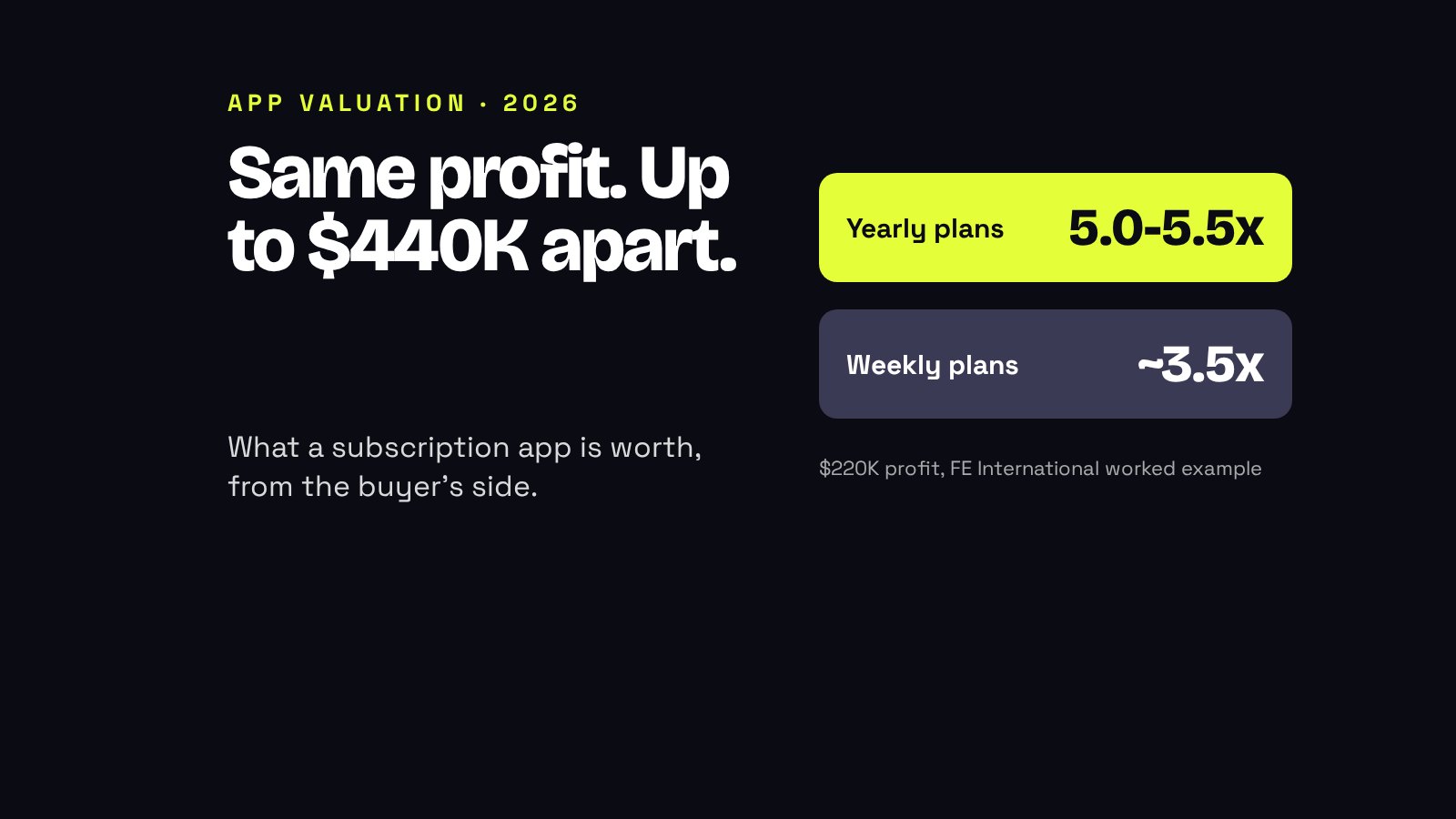
3. Recurring, retained revenue. Retention by cohort and by renewal is what pushes a subscription app to the top of its band. Yearly plans keep far more subscribers after a year than monthly or weekly ones (RevenueCat, State of Subscription Apps). More in how much a subscription app is worth.
4. Margins and clean books. Profitable SaaS on Acquire.com averaged about 71% margins in 2025 (Acquire.com). Buyers price net revenue after store fees and refunds, with every add-back documented.
5. Age and owner dependency. An app that has held its place in the store for years, and runs without the founder on every decision, nearly always gets the better multiple (Empire Flippers, FE International).
What I'd do before selling, from the buyer's side of the table
1. Find your band first. Know which row of the table you are in, so you negotiate inside the right range instead of against a number from another model.
2. Build 12 clean months. Store payouts matched to the bank, net of fees and refunds, every add-back explained.
3. Add one more acquisition channel. Even a small second source of users reads as lower risk.
4. Export cohorts and renewals. Retention you can show beats retention you describe.
5. Do not cut marketing to look profitable. A last-quarter profit jump buys questions, not a higher multiple.
Want your number instead of a range? Run your app through our free valuation calculator. Then read how to sell your app to a company and what selling your app to us costs.
FAQ
What is a typical app exit multiple in 2026?
Most small and mid-sized apps sell for about 2x to 6x yearly profit. FE International puts subscription apps with real retention at 3.5x-6.0x adjusted earnings and ad-funded utility apps at 1.8x-3.5x; Empire Flippers prices apps at 1.7x to 5x+ of the last 12 months of net profit.
Are apps valued on revenue or on profit?
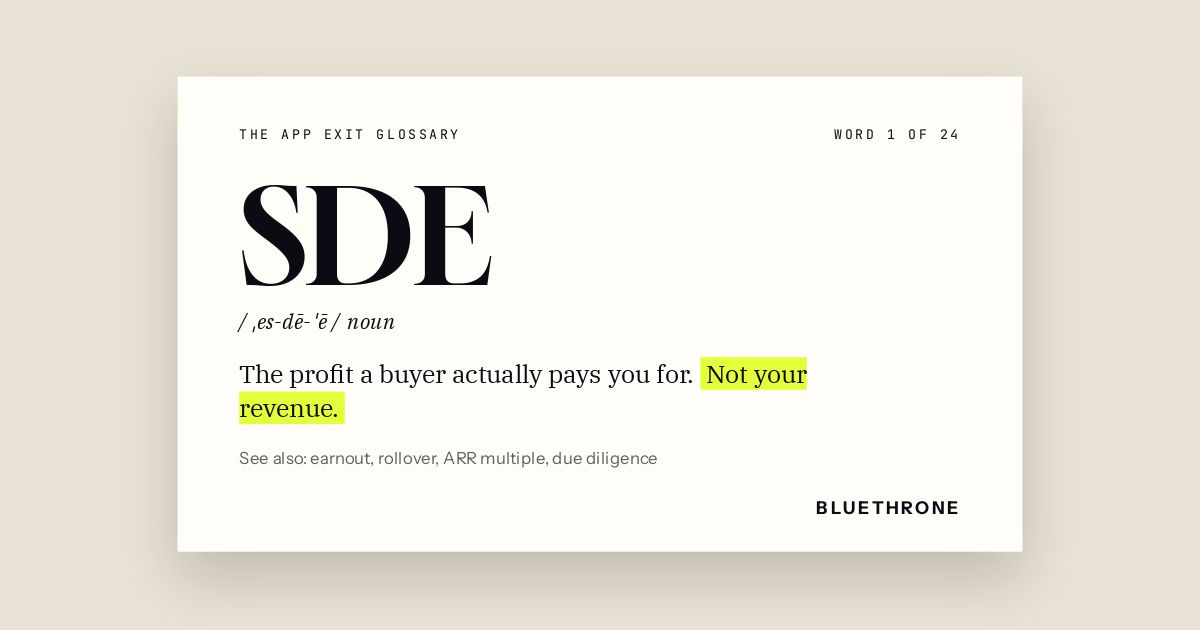
Mostly on profit: seller's discretionary earnings (SDE) below about $5M in value, EBITDA above that. Revenue multiples apply when growth is above about 20% a year with gross margins above 70% (FE International).
What multiple do SaaS and B2B apps sell for?
Acquire.com reports a 3.9x median profit multiple for SaaS in both 2024 and 2025, with averages in the low-to-mid 4x range. Flippa puts smaller owner-operated SaaS at about 2.5x-4.5x profit in H1 2026.
Why do two apps of the same size sell for very different multiples?
Because buyers price how long the profit will last and how much of it they can verify. On Flippa in H1 2026, top-quartile deals in the same size band sold for 1.6x to 2.7x the average multiple.
Is there a separate multiple for games or in-app-purchase apps?
Not in the public data from the major marketplaces and advisors. They are priced inside the general app range, 1.7x to 5x+ net profit on Empire Flippers, based on the same drivers: history, retention, channels and margins.
How do I estimate my app's value quickly?
Take net profit for the last 12 months, add back your own pay and one-off costs, find your business-model band in the table above, and place yourself in it by retention, channel mix and how clean your books are. Or use BlueThrone's free valuation calculator.
Written by Idan Waller, co-founder of BlueThrone. We buy and grow mobile apps, so we price app exits from the buyer's side every week. Figures are from the public reports linked above, not from BlueThrone deals.


Keep reading








Time for
your exit?