Korea forces Apple & Google to allow payment links: what app founders should do now

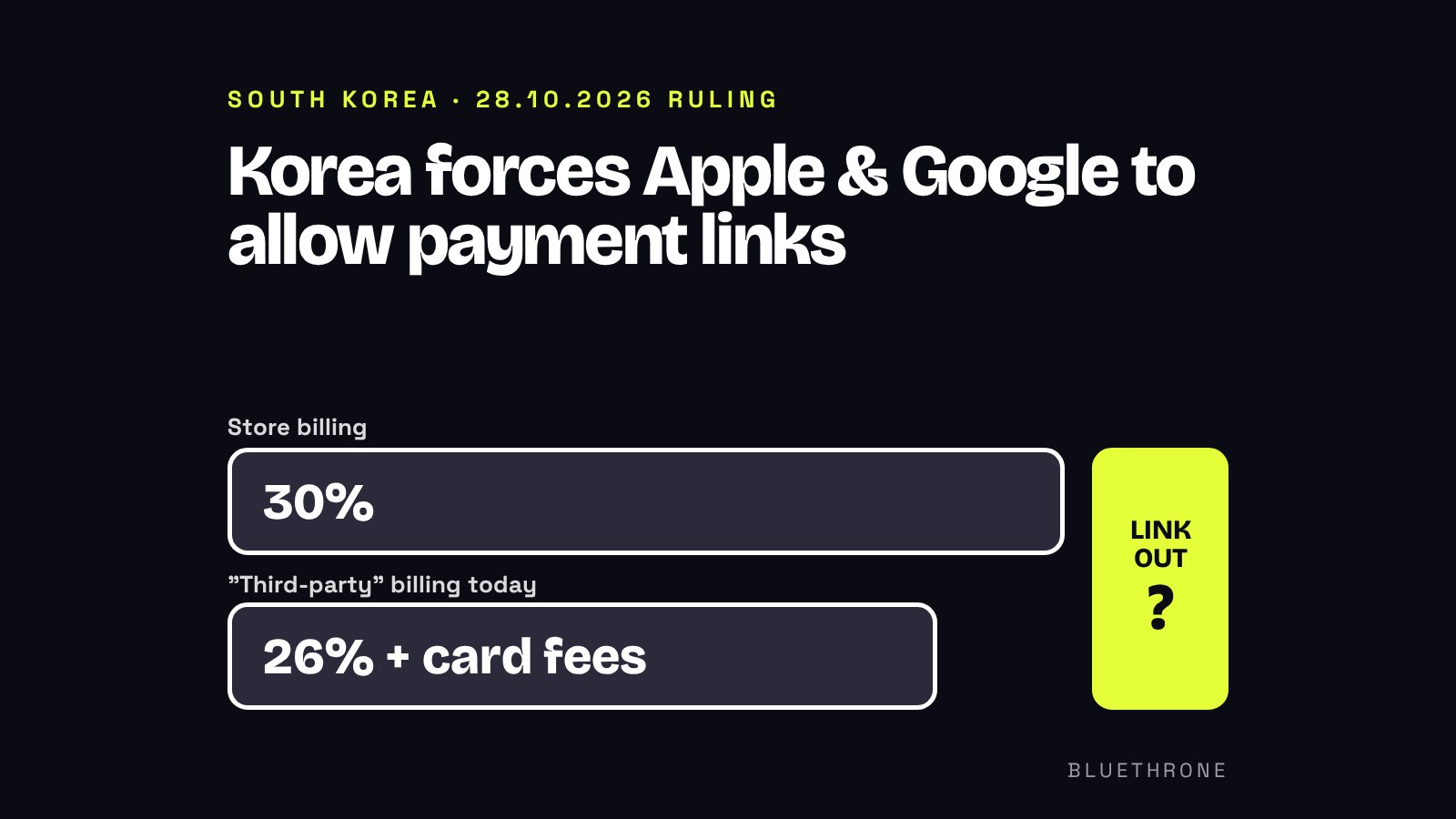
Short answer: On October 28, 2026, South Korea's media regulator (KMCC) fined Google 42.9 billion won and Apple 20.81 billion won (about $47.6M combined) and ordered both to let developers link from inside the app to an external payment page and to fix their commission policies (Korea Times, MacRumors/AP). They must submit a plan within one month of receiving the orders and finish the changes within three months (Korea JoongAng Daily). Apple says it disagrees and is evaluating its options. For founders: don't switch billing yet, but get a web checkout ready for your Korean users.
If you have paying users in South Korea, you have been paying the store tax there with no real way out. That just changed on paper. In practice, the clock is ticking, and the founders who prepare now will be the ones who keep the margin.
The 30-second version
On October 28, 2026, South Korea's media regulator (KMCC) fined Google 42.9 billion won and Apple 20.81 billion won (about $47.6M combined) and ordered both to let developers link from inside the app to an external payment page and to fix their commission policies (Korea Times, MacRumors/AP). They must submit a plan within one month of receiving the orders and finish the changes within three months (Korea JoongAng Daily). Apple says it disagrees and is evaluating its options. For founders: don't switch billing yet, but get a web checkout ready for your Korean users.
Why the old "choice" was not a choice
Since 2021 Korean law has said stores can't force their own billing. Both stores did allow third-party payments inside the app, but at a 26% commission, only 4 points below the standard 30%. Once you add your own payment processor fees and the cost of running a payment system, the regulator's finding was that the real cost "can be similar to or even greater than" the store's own billing (Seoul Economic Daily). Google limited how you could show prices per payment method, and Apple required a separate app for third-party payments (Korea JoongAng Daily). So almost nobody switched.
Two more findings matter to app owners: both stores delayed app reviews without clear reasons or timelines, and Apple charged Korean developers its 30% on the price including VAT from July 2015 to January 2023, while overseas developers paid on the price excluding VAT (Seoul Economic Daily).
What founders are saying
So far, the coverage quotes the regulator, Apple and Google, not developers. We haven't found a Korean app founder on record about this ruling yet, so we won't put words in anyone's mouth. What we can do is tell you how it looks from where we sit: across the table from founders, buying their apps.
What it means for you, founder by founder
What changes: very little for now.
Should you act? only to check the number.
What I'd do: pull revenue by country from App Store Connect, Play Console or RevenueCat. If Korea is small, file this under "watch" and move on.
What changes: within about three months of the orders, you should be able to send Korean users to your own checkout from inside the app.
Should you act? prepare now, switch later.
What I'd do: set up a web checkout (a merchant of record or your own processor) and a Korean-language pricing page, so you can test a link the week it's allowed. Don't move to the 26% option in the meantime: the regulator itself says it isn't cheaper.
What changes: a lower fee on part of your revenue means more profit, and buyers pay a multiple of profit.
Should you act? yes, but with data, not promises.
What I'd do: if you move Korean payers to the web, track it as its own line: share of users, conversion and refunds. As buyers we only credit a margin improvement once we see it in real months of data, not in a forecast. See how we value an app.
The buyer's math (one illustration)
This is a hypothetical example, not a prediction: say your app makes $100K a month and 10% of it comes from Korea. If half of those Korean payers move to a web checkout that costs you about 5% instead of 30%, you keep roughly $1,250 more profit a month, about $15,000 a year. At a typical 3x profit multiple, that's on the order of $45,000 of extra value, but only once you can show it. Whether the stores will charge any commission on linked-out payments is still unclear, and that changes the math.
Your checklist for this week
- Check what share of your revenue and payers is in South Korea.
- Don't switch to the 26% "third-party" option to save money: the regulator found it isn't cheaper.
- Prepare a web checkout and a Korean pricing page so you can test a link fast.
- Watch for Apple's and Google's implementation plans (due about a month after they receive the orders) and Google's December 31 changes.
- Selling soon? Track any payment change as its own line from day one. Check what your app is worth first, so you know what the margin is worth to a buyer.
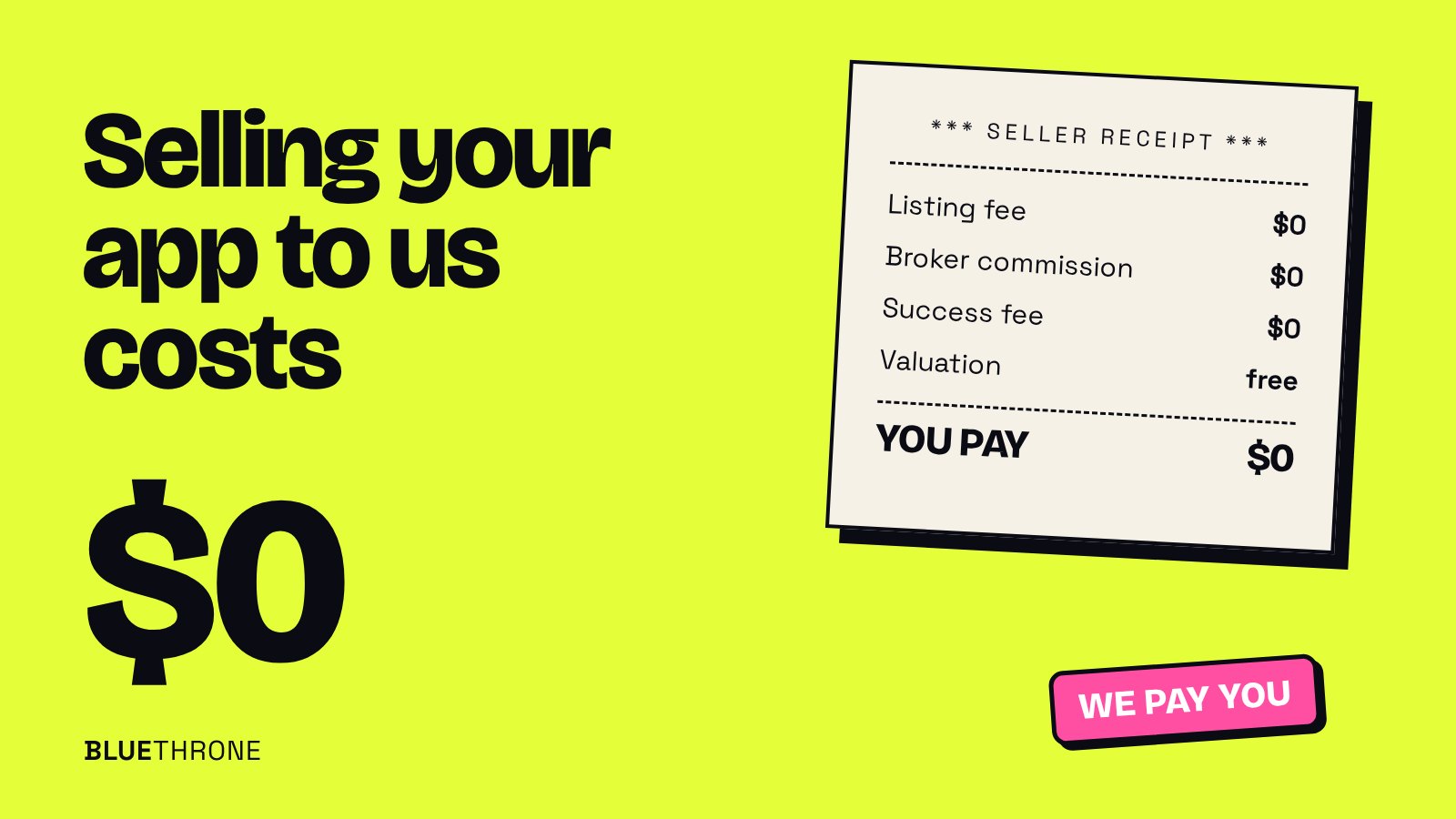
Thinking about selling? Read how to sell your app to a company, and know that selling to BlueThrone costs you $0 in fees.
FAQ
What did South Korea decide about Apple and Google on October 28, 2026?
The Korea Media and Communications Commission fined Google 42.9 billion won and Apple 20.81 billion won and ordered both to allow in-app links to external payment pages and to revise their commission policies.
When do the changes take effect?
The companies must submit implementation plans within one month of receiving the corrective orders and complete the changes within three months, then report the results.
Is the current 26% third-party payment option cheaper than store billing?
Usually not. The regulator found that with your own payment processor fees and system costs, the real cost can be similar to or higher than the stores' own billing.
Will Apple charge a commission on linked-out payments in Korea?
Not yet known. Reports differ on whether the order sets fees for link-out payments, and Apple says it is evaluating its options.
Does this affect my app's valuation?
It can, if moving Korean payers to the web lowers your fees and raises profit. Buyers usually credit that only after several months of real data, not as a forecast.
Written by Idan Waller, co-founder of BlueThrone. We buy and grow mobile apps, so we read every store rule change from the founder's side of the table.


Keep reading







Time for
your exit?