Aomi Sold for HK$754M in Gold and Crypto: Exit Analysis for App Founders

Short answer: On October 15, 2026, Cityhill, a subsidiary of Hong Kong-listed Elate Holdings, agreed to buy 69% of AOMI Corporation, the company behind the Aomi app, for up to HK$754 million (about US$96 million, per Dealroom). HK$534 million is paid at completion in gold bullion and a cryptocurrency called MUP, and up to HK$220 million more comes later if profits grow. The whole company is valued at about HK$774 million, roughly 22x its profit.
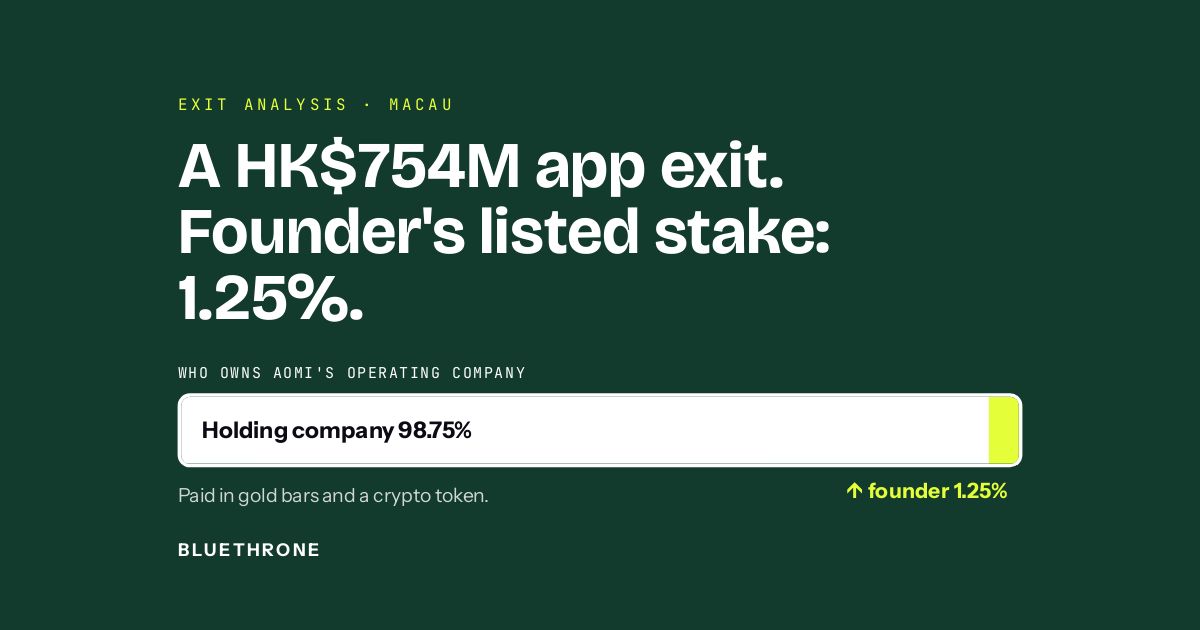
A HK$754 million exit. The founder's listed stake: 1.25%. Macau's biggest food delivery app just sold control to a Hong Kong-listed company, and the buyer is paying in gold bars and a crypto token. The press covered the gold. We read the 27-page filing from the founder's side, because that's where the lessons are.
The 30-second version
On October 15, 2026, Cityhill, a subsidiary of Hong Kong-listed Elate Holdings, agreed to buy 69% of AOMI Corporation, the company behind the Aomi app, for up to HK$754 million (about US$96 million, per Dealroom). HK$534 million is paid at completion in gold bullion and a cryptocurrency called MUP, and up to HK$220 million more comes later if profits grow. The whole company is valued at about HK$774 million, roughly 22x its profit.
1. The founder's story: from a bank job to Macau's delivery app
Jiang Haitao, who goes by Acen, left a stable banking job in 2011 to do an MBA at the University of Macau and start a company at the same time. Aomi was his third venture. In 2014 he saw that ordering food on apps was already a habit in mainland China, and started as a local agent for those platforms. In his words: "After introducing the platforms to Macao, our team came up with the idea of developing a lifestyle service platform specifically for the local residents. The 'Aomi' app was born accordingly, and it was officially launched online in 2016."
Then he made the move most founders don't: he refused to copy the giant next door. "Instead of creating a Macao version of Meituan, our aim is to develop a platform to provide more comprehensive, convenient, and high quality lifestyle service for local residents and travelers." Aomi grew from food delivery into supermarket delivery, group buying and services, and the filing now calls it "Macau's leading mobile platform for ordering and delivery services".
2. The part the headlines skipped: who actually gets paid
Here's the line that stopped us. The seller is not the founder. It's Han Carvestone International, a British Virgin Islands holding company whose ultimate owner the filing names as Mr. Liu Yuehai, "a businessman who primarily focuses on equity investments". The founder appears once, as the holder of a 1.25% direct stake in the operating company, and, per the filing, an employee of the buyer's group since 2021, recruited to lead its internet projects.
The filing doesn't say how ownership got here, and we won't guess. Founders sell stakes, raise money and restructure for good reasons. But read it as a founder: you can build the number one app in your market, and the exit price can still be someone else's exit.
The price is not your payout. Your payout is the price times what you own on the day of the sale, minus what you are paid in. Check your cap table before you check your valuation.
3. Why a delivery app gets 22x profit when most apps get 2x to 5x
Most small, owner-run apps sell for about 2x to 5x annual profit (see our app valuation guide). Aomi was valued at about 21.7x trailing profit, 26.4x annualized 2026 profit, and roughly 2.2x revenue by our math. The independent valuer benchmarked it against listed delivery platforms, with a median of 2.71x revenue. Three things earned that multiple:
- It's profitable and growing. Profit after tax went from MOP 25.5 million in 2024 to MOP 32.9 million in 2025, up 29%, on about MOP 369 million in revenue.
- It owns its market. Restaurants, riders and customers in one city all run through one app. That three-sided network is very hard to copy.
- The buyer is paying for earnings, not stuff. Net assets were only about MOP 13.5 million in June 2026. Almost the whole price is the profit and the network.
Profit growth is what moves the multiple. Not downloads or press. A 29% profit jump with a dominant local position got valued like a listed company. If you sell, sell while the profit line points up.
4. Paid in gold bars and a crypto token
The completion payment is settled in gold bullion and MUP (Multiple Up Point), a cryptocurrency on the Polygon network that trades on exchanges called Klickl and Richberg. The earnout is the interesting part. If Aomi's average audited profit for 2026 and 2027 beats its 2025 profit, the seller gets the difference times 24.04, capped at HK$220 million, and paid in MUP at the price on the day before payment.
From the seller's chair, that means two bets at once: that the profit grows, and that the token holds its value until the payment date. A cash earnout only carries the first risk.
What you are paid in is part of the price. Cash at close beats everything else. If part of your price is an earnout, get the formula, the cap, the measuring period, who audits the numbers and the payment currency in writing. Aomi's formula is in a public filing. Yours should be at least that clear.
5. What you can steal for your own app
Aomi: "Instead of creating a Macao version of Meituan..."
You: beat the giant on the one market or niche it doesn't care about, then widen what you do for those same users.
Aomi: three years of profit and a half-year of management accounts were on the table.
You: buyers pay for numbers they can verify. Clean, monthly, from the source. Get yours with our free valuation before anyone else prices you.
Aomi: the founder's listed stake is 1.25%.
You: every round, partner and side deal changes who gets paid at the end. Model your payout, not just the price.
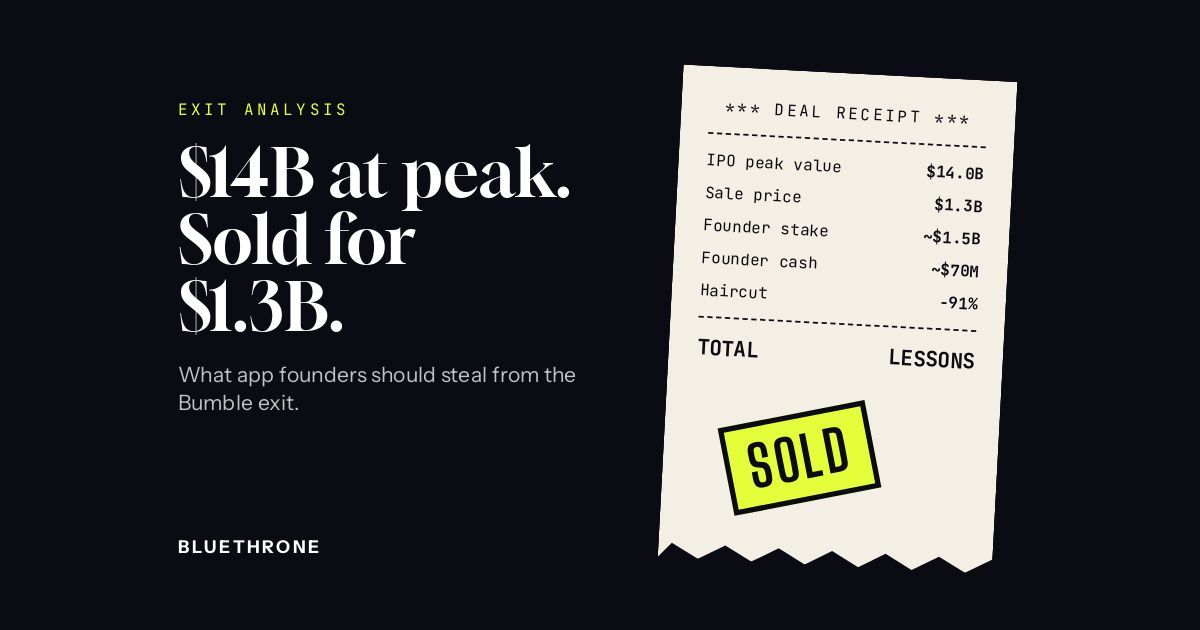
Thinking about your own exit? Start with how to sell my app, or read how Bumble sold for $1.3B.
FAQ
Who is buying Aomi?
Cityhill Limited, a wholly owned subsidiary of Hong Kong-listed Elate Holdings (stock code 076), agreed on October 15, 2026 to buy 69% of AOMI Corporation, the holding company behind the Aomi app.
How much did Aomi sell for?
Up to HK$754.06 million for 69%: HK$534.06 million at completion, plus up to HK$220 million more if profits grow. The filing values 100% of the company at about HK$774 million.
How is the Aomi deal being paid?
In gold bullion and MUP (Multiple Up Point), a cryptocurrency on the Polygon network. Any earnout is paid in MUP only.
What multiple did Aomi sell for?
About 21.7x its trailing 12-month profit and 26.4x its annualized 2026 profit, per the filing. On 2025 revenue of about HK$358 million, the HK$774 million valuation is roughly 2.2x revenue by our math.
Who founded Aomi?
Jiang Haitao (Acen), a University of Macau MBA graduate who left a banking job in 2011. Aomi launched in 2016. The filing lists him with a direct 1.25% stake in the operating company.
Has the Aomi deal closed?
No. It is a very substantial acquisition under Hong Kong listing rules and needs shareholder approval. The financial figures in the filing are unaudited.
Written by Idan Waller, co-founder of BlueThrone. We buy and grow mobile apps, so every exit we analyze is read from the founder's side of the table. This is part of our Exit Analysis series.


Keep reading








Time for
your exit?