Did SuperPlay's founders get rich? $700M in cash, plus an earnout now estimated at $829M

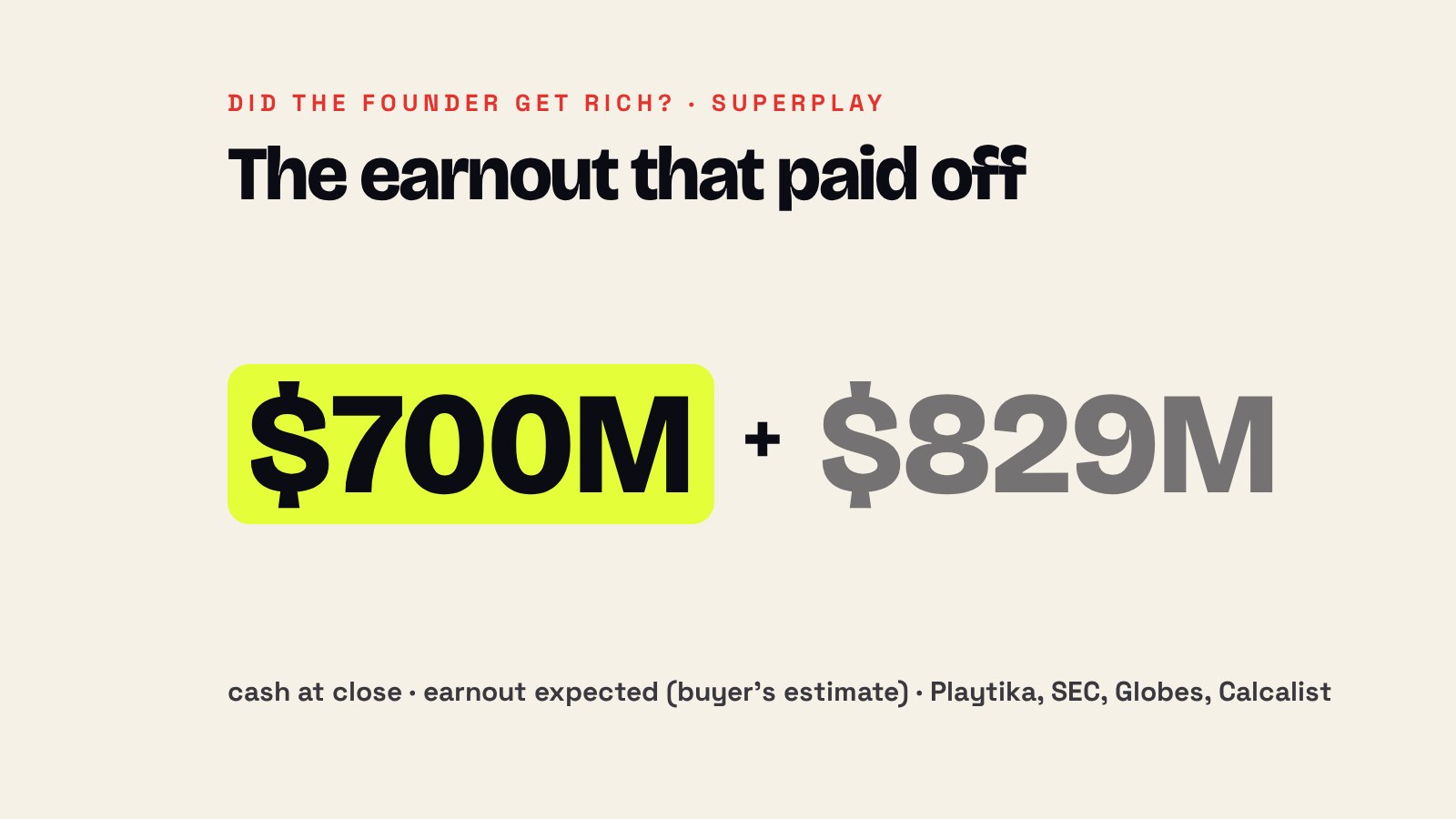
Short answer: Did SuperPlay's founders get rich? Yes, in cash, at close. Playtika bought the Israeli mobile games studio (Dice Dreams, Domino Dreams, Disney Solitaire) for $700 million up front, funded from its balance sheet, plus an earnout of up to $1.25 billion tied to SuperPlay's revenue and Adjusted EBITDA in 2025, 2026 and 2027 (Playtika release, SEC). SuperPlay then did about $573 million in revenue in 2025, 67% above the $342 million earnout threshold (Globes), and Playtika raised its estimate of what it still owes the sellers to $829 million (Calcalist). That second payday is the earnout doing exactly what it is for: paying the founders for growth they delivered after the sale.
Most headlines tell SuperPlay's earnout as Playtika's headache. From the founders' side, it is one of the best earnouts in mobile gaming: they beat the target by 67%, and a $700 million sale is now on track to pay the sellers an estimated $829 million more. Here is how it worked, with sources.
The 30-second version
Did SuperPlay's founders get rich? Yes, in cash, at close. Playtika bought the Israeli mobile games studio (Dice Dreams, Domino Dreams, Disney Solitaire) for $700 million up front, funded from its balance sheet, plus an earnout of up to $1.25 billion tied to SuperPlay's revenue and Adjusted EBITDA in 2025, 2026 and 2027 (Playtika release, SEC). SuperPlay then did about $573 million in revenue in 2025, 67% above the $342 million earnout threshold (Globes), and Playtika raised its estimate of what it still owes the sellers to $829 million (Calcalist). That second payday is the earnout doing exactly what it is for: paying the founders for growth they delivered after the sale.
Headline price: up to $1.95B = $700M up front + up to $1.25B earnout (announced September 18, 2024, closed November 2024).
Founder stake: not disclosed. SuperPlay raised an estimated $30-35M (Globes) to over $50M (Calcalist) from VCs, so the founders shared the pot with investors and employees.
Cash at close vs earnout: ~$690-700M cash to all sellers at close. Earnout still owed, by Playtika's latest estimate: ~$829M, paid from Playtika's cash flow over 2025-2027 results.
Our math (estimate): every 10% of SuperPlay = about $70M cash at close, plus about $83M more if the $829M estimate is paid in full.
Years it took: about 5 years from founding (2019) to the cash at close; the earnout runs on 2027 results.
Verdict: LIFE-CHANGING, already in cash at close, and the earnout they earned could roughly double it.
The timeline
| When | What happened | What it meant for the founders |
|---|---|---|
| 2019 | Gilad Almog and Eyal Netzer, both former Playtika employees, found SuperPlay with industry veteran Elad Drory (Playtika). | They leave the company that would later buy them. |
| 2019-2024 | Raise an estimated $30-35M in three rounds (Globes); Calcalist puts it at over $50M (Calcalist). | Dilution, but a small raise for a studio that later sold for $700M+. |
| Sep-Nov 2024 | Playtika agrees to buy SuperPlay: $700M up front + up to $1.25B earnout on 2025-2027 revenue and Adjusted EBITDA (SEC); the deal closes in November (SEC). | Cash at close, and a three-year bet on themselves. |
| 2025 | SuperPlay does ~$573M in revenue, 67% over the $342M threshold; Playtika books a ~$309M Q4 loss, mainly from revaluing the earnout (Globes). | The bet is paying, on paper, much bigger than planned. |
| 2026 | Estimate of the remaining earnout rises from $734M to $829M; Playtika holds talks to sell SuperPlay to Tencent at a $1-1.5B valuation (Calcalist). | The earnout keeps growing with the studio. |
| Nov 5, 2026 | Playtika ends its strategic review: no sale, it stays independent; the stock jumps 12% (Globes). | The earnout stays with Playtika. |
In their own words
We haven't found an interview where the founders talk about their own payout or the earnout, so we won't put words in their mouths.
Three lessons for any app founder looking at an earnout
What happened: SuperPlay beat its 2025 threshold by 67%, and the estimate of what the sellers will receive kept rising, from $734M to $829M.
Lesson: if you know your next 2-3 years will be bigger than the last, an earnout lets you get paid for that, on top of the price for what you have today.
What happened: the targets were set on two clear numbers, revenue and Adjusted EBITDA, year by year for 2025-2027.
Lesson: clear, simple metrics you control are what make an earnout work. Agree on the definitions before you sign, not after.
What happened: Playtika pays the earnout from its own cash flow, and SuperPlay's success made the payments bigger than anyone planned.
Lesson: when you sell with an earnout, the buyer's strength is part of the deal. Ask how it is funded and what happens if the buyer changes.
What we'd tell a founder in their shoes
We buy apps, and we use earnouts too. Done right, they let a buyer pay more than a cash-only price would justify, and let the founder share in the growth they still believe in. SuperPlay shows the upside: the founders bet on themselves and won big. If you are selling, look at the whole offer, the cash at close and the earnout, and make sure the targets are clear and the buyer can fund them. Check what your app is worth, or read how to sell your app to a company. For another founder story, see episode 1, Bumble.
FAQ
Did SuperPlay's founders get rich from the Playtika sale?
Yes. Playtika paid about $700 million in cash up front in November 2024, split between the founders, investors and other shareholders, plus an earnout that Playtika now estimates at about $829 million more.
How much did Playtika pay for SuperPlay?
$700 million up front plus up to $1.25 billion in earnout payments based on SuperPlay's revenue and Adjusted EBITDA in 2025, 2026 and 2027, for a total of up to $1.95 billion.
Why did the SuperPlay earnout grow so much?
SuperPlay grew much faster than planned: about $573 million in 2025 revenue versus a $342 million threshold. Playtika raised its estimate of the remaining payments from $734 million to $829 million.
Who founded SuperPlay?
Gilad Almog and Eyal Netzer, both former Playtika employees, with industry veteran Elad Drory, in 2019.
What should an app founder learn from the SuperPlay earnout?
A well-built earnout can multiply an exit: SuperPlay beat its target by 67% and the expected payments rose to about $829 million. Agree on clear metrics, and choose a buyer that can fund the upside.
Written by Idan Waller, co-founder of BlueThrone. Part of our series "Did the founder get rich?": we judge every exit by one question, how much the founder took home in cash.


Keep reading







Time for
your exit?