Did Character.AI's founders get rich? $2.7B from Google in 2024, a $20M bid in bankruptcy in 2026

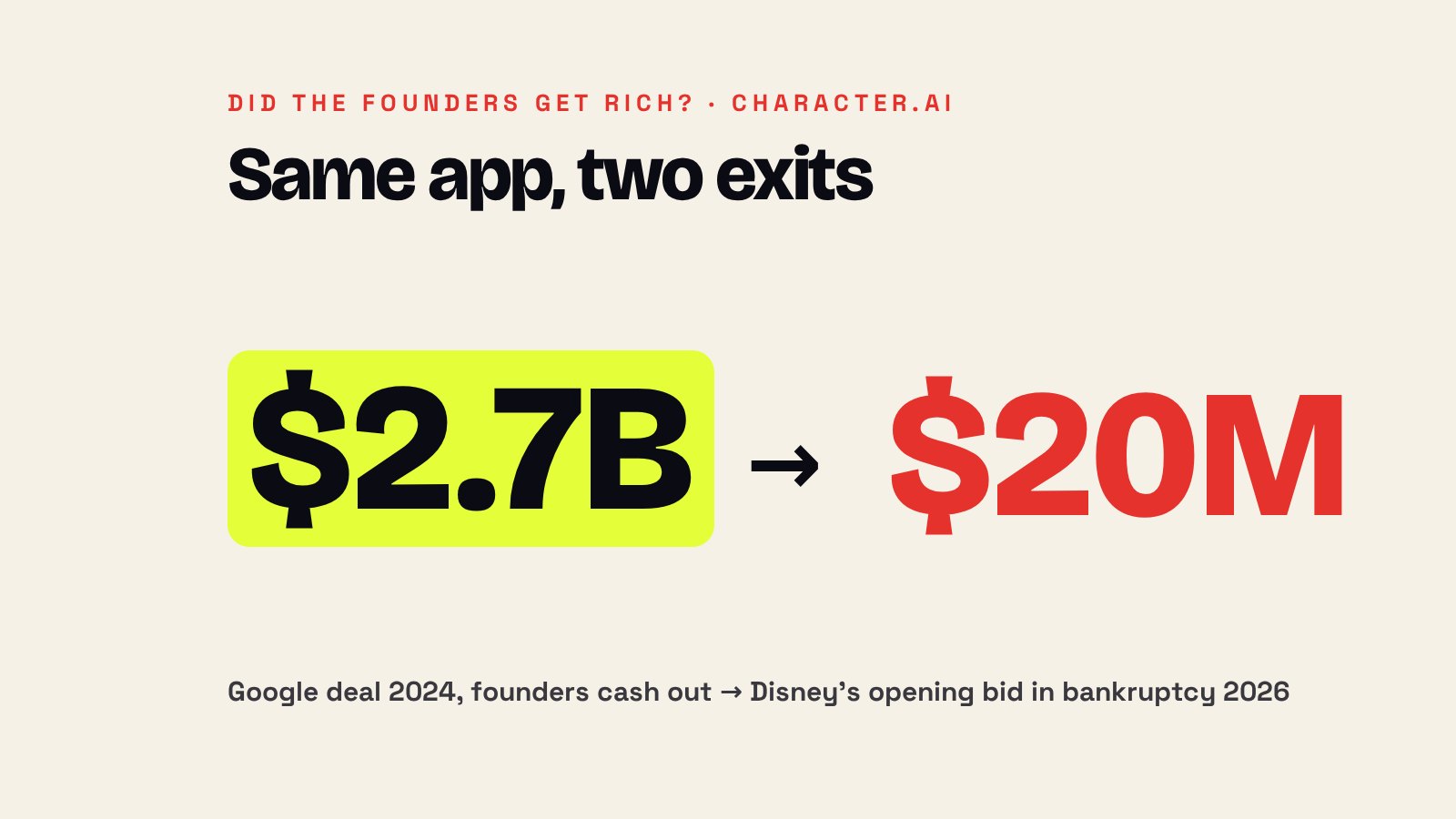
Short answer: Did Character.AI's founders get rich? Yes, back in 2024. Google's roughly $2.7 billion licensing deal in August 2024 bought out existing investors and brought co-founder Noam Shazeer back to Google, and the Wall Street Journal reported he made hundreds of millions of dollars from his stake (PYMNTS, Benzinga, citing the WSJ). The company that stayed behind filed for Chapter 11 in October 2026, citing costs and litigation, with Disney as the first bidder at $20 million for a non-exclusive license to some of its IP (CNBC, Yahoo Finance). That is less than 1% of the 2024 deal.
In 2024 Google paid about $2.7 billion to license Character.AI's technology and bring its founders back. In October 2026 the company filed for bankruptcy, and Disney opened the bidding for some of what is left at $20 million. Same app, two years apart. Here is who got rich, and when.
The 30-second version
Did Character.AI's founders get rich? Yes, back in 2024. Google's roughly $2.7 billion licensing deal in August 2024 bought out existing investors and brought co-founder Noam Shazeer back to Google, and the Wall Street Journal reported he made hundreds of millions of dollars from his stake (PYMNTS, Benzinga, citing the WSJ). The company that stayed behind filed for Chapter 11 in October 2026, citing costs and litigation, with Disney as the first bidder at $20 million for a non-exclusive license to some of its IP (CNBC, Yahoo Finance). That is less than 1% of the 2024 deal.
Noam Shazeer (co-founder, CEO until 2024): hundreds of millions of dollars from his stake in the 2024 Google deal, per the WSJ. Exact amount not disclosed.
Daniel De Freitas (co-founder): moved to Google with Shazeer in 2024. His payout was not disclosed.
When the cash came: in 2024, at the top, about two years before the bankruptcy.
Verdict: life-changing, in cash, for the founders and the investors who were bought out in 2024. The 2026 sale pays the company's creditors.
Two exits from one app
Most founders get one shot at an exit. Character.AI had two, and they could not look more different.
Exit one, August 2024: Google paid about $2.7 billion for a non-exclusive license to the technology, money that also bought out existing investors, and it hired Shazeer, De Freitas and part of the research team back (PYMNTS). Shazeer had left Google in 2021 after it would not ship his chatbot. Three years later Google paid billions to get him back.
Exit two, October to December 2026: what stayed behind, the consumer app, its users and its legal bills, went into Chapter 11. Disney signed up as the stalking-horse bidder at $20 million for a non-exclusive, perpetual license to some of the IP, plus help from former employees Disney hired (CNBC). The rest of the assets go to auction, and the sale is expected to close in late November or early December.
Who gets paid in the 2026 sale
In a bankruptcy sale the money goes to creditors first. A small detail shows how thin $20 million is: the US Trustee objected to the investment bank's fee, which would be at least $2.05 million, about 10.25% of the Disney price (PPC Land). Separately, a $10 million sale of the app, models and user chats to a newly formed company has been reported, with the court asking a privacy ombudsman to review it (FourWeekMBA). We treat that one as reported, not confirmed.
What we'd tell a founder in their shoes
1. Sell while someone wants you. In 2024 a buyer was paying billions. In 2026 the same brand drew a $20M opening bid in court, with the cash running out and no leverage left.
2. Know what your costs do to your price. CNBC's report names costs and litigation as the reasons for the filing. If your margins depend on expensive AI calls or ads, buyers price that risk in, and a forced sale prices it in all the way. Check where you stand with our free app valuation.
3. Selling your users' data needs their consent. A chat app's biggest asset is its user history, and the court is reviewing whether it can move at all. Clean consent and a clear privacy policy are part of your price, see our app due diligence checklist.
4. Watch the fees on small deals. At $20M, a 10% banker fee is a big slice. When you sell your app directly to a buyer like BlueThrone, there is no broker fee and no listing fee.
FAQ
Did Character.AI's founders get rich?
Yes, in 2024. Google's roughly $2.7 billion licensing deal brought co-founder Noam Shazeer back to Google, and the Wall Street Journal reported he made hundreds of millions of dollars from his stake. Co-founder Daniel De Freitas also joined Google; his payout was not disclosed.
Why did Character.AI file for bankruptcy?
Character.AI filed for Chapter 11 in October 2026, citing costs and litigation, according to CNBC.
How much is Disney paying for Character.AI?
Disney is the stalking-horse bidder at $20 million for a non-exclusive, perpetual license to some of Character.AI's IP, plus transition help from former employees it hired. It is buying a license, and other bidders can still top the offer at auction.
How much did Google pay for Character.AI?
About $2.7 billion in August 2024, for a non-exclusive license to the technology. The deal also bought out existing investors and rehired the founders.
What can app founders learn from Character.AI?
Sell while buyers want you: the same brand went from a $2.7B deal to a $20M opening bid in bankruptcy two years later. Keep costs, user-data consent and legal risk clean, because buyers price all three.
Written by Idan Waller, co-founder of BlueThrone. Part of our series "Did the founder get rich?": we judge every exit by one question, how much the founder took home in cash.


Keep reading







Time for
your exit?