Bumble Sold for $1.3B: Exit Analysis for App Founders

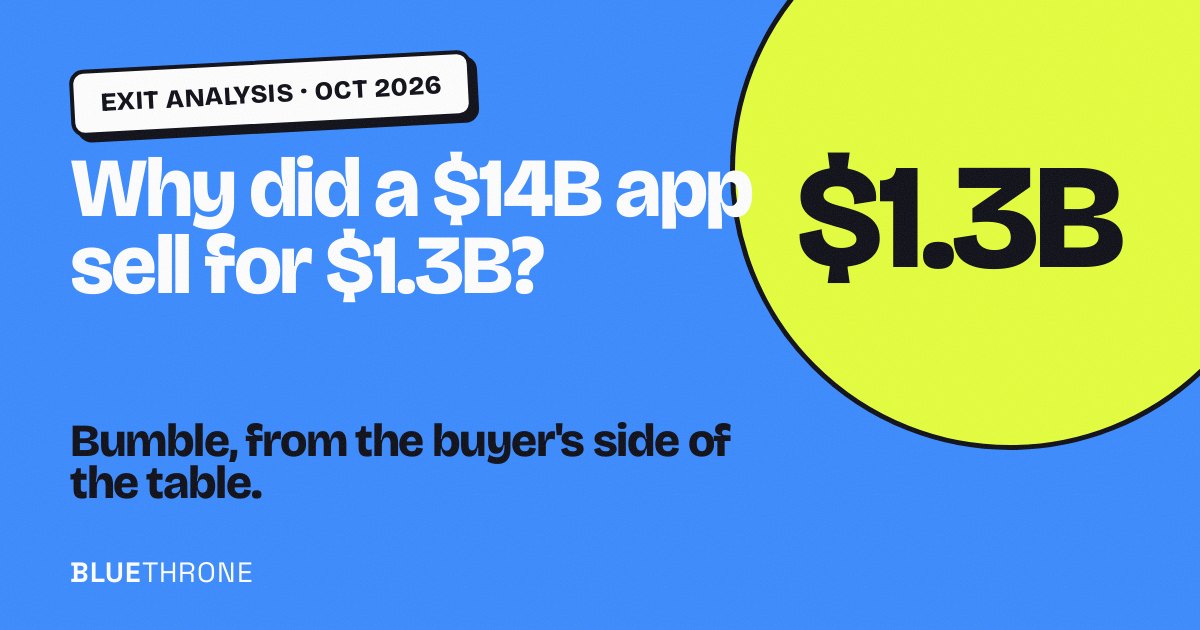
Short answer: On October 13, 2026, Bumble agreed to be bought by Ithaca Holdings for $1.3 billion in cash: $6.05 a share, about 138% above where the stock closed on October 9. Bumble goes private, Ithaca's co-CEOs Ravi Gupta and John Hegeman take over as co-CEOs, and Whitney Wolfe Herd stays in the building.
$14 billion in 2021. $1.3 billion last week. Bumble didn't crash, didn't fail, didn't get banned. It waited. And if you run an app right now, you are probably waiting too. This is what nobody told Bumble, and what nobody is telling you, from the people who actually buy apps.
Tough love up front: buyers don't pay for your past. Not your best year, not your press, not your IPO. They pay for where the line is going. If your MRR is climbing today, today is your selling window. "One more year" is exactly how $14B becomes $1.3B.
The 30-second version
On October 13, 2026, Bumble agreed to be bought by Ithaca Holdings for $1.3 billion in cash: $6.05 a share, about 138% above where the stock closed on October 9. Bumble goes private, Ithaca's co-CEOs Ravi Gupta and John Hegeman take over as co-CEOs, and Whitney Wolfe Herd stays in the building.
That 2021 number is the one Semafor reported at the IPO. The 2026 numbers are the ones TechCrunch pulled from Bumble's Q2 results. Read them twice. That gap is the whole story. Read it until it hurts.
1. What made Bumble special
One rule. In a match between a man and a woman, the woman sends the first message. That single product decision fixed a real pain, gave people a story to tell their friends, and made Bumble impossible to confuse with anything else in a crowded category. Wolfe Herd launched it in December 2014, right after leaving Tinder.
Then she stretched the same brand into new jobs: Bumble BFF for friends in 2016 and Bumble Bizz for networking in 2017. One brand people trust, more reasons to open the app every day.
And here is the twist nobody wants to hear: this year Bumble dropped the women-first rule while it fought falling users. The thing that made it special became optional. When your positioning becomes a setting, you become a commodity. And commodities get commodity prices.
2. How much was it worth, and why so much less than 2021?
$1.3 billion, in cash. In Q2 2026 Bumble made $211 million in revenue. Annualize that one quarter (about $844 million a year) and the deal lands at roughly 1.5x yearly revenue. That is our napkin math, not a number from the deal.
Why so far below the IPO? Because buyers price the trend, not the trophy cabinet. Paying users fell 16.4%, revenue fell 15.2%, and the whole swipe category is under pressure. Feel that slow-growth "am I a loser?" knot about your own MRR? Good. Billion-dollar companies feel it too. The difference: the ones who act on it early get paid. The ones who wait get Bumble'd.
So why pay a 138% premium? Because the stock was on the floor, and what Ithaca is really buying is not this quarter. In their words, "a trusted brand and loyal community". Going private also gives Bumble room to rebuild without explaining every bad quarter to Wall Street.
Shrinking users: push the multiple down.
A brand people trust: puts a floor under the price.
A plan to rebuild in private: is where the buyer expects to make the money back.
3. How Bumble got its users
No giant ad budget. In Wolfe Herd's own telling to CNBC, she had cookies frosted in Bumble yellow and delivered them to a sorority, and dropped off pizza with bee stickers at fraternities. Students downloaded, started matching, and in her words, "that's when the snowball effect really started."
The real trick was density. A dating app with nobody in it is a ghost town, and every indie dev who launched to crickets knows that silence. Starting inside tight campus communities meant every new user found other users on day one. Bumble later turned it into a program, like the First Movers Club at UT Austin in 2019.
BFF and Bizz reused the same audience, Bumble passed 100 million downloads by July 2020, and in February 2021 it priced its IPO at $43 a share.
4. What you can steal for your own app
Bumble: women message first.
You: find the one rule your users repeat to a friend. Then guard it with your life. Touch it, and you are just another app.
Bumble: one campus at a time.
You: if your app needs other users, stop chasing the world. Pack one city, one niche, one community. An empty room kills a networked app faster than any paywall.
Bumble: ~$14B on the way up, $1.3B with paying users shrinking.
You: sell while the line still points up. Nobody sees the peak. You only see it in the rear-view mirror.
Bumble: the buyer named the trusted brand and loyal community.
You: retention and reviews are not vanity metrics. They are the floor under your price. Treat them like cash, because they are.
FAQ
Who is buying Bumble?
Ithaca Holdings, a holding company for technology businesses led by co-CEOs Ravi Gupta and John Hegeman, announced on October 13, 2026.
How much did Bumble sell for?
About $1.3 billion in an all-cash deal, or $6.05 per share of Class A common stock, roughly a 138% premium to the unaffected closing price on October 9, 2026.
What was Bumble worth at its IPO?
Bumble went public in February 2021 at $43 per share and was valued at roughly $14 billion around its listing.
Why did Bumble sell for less than its IPO value?
Its paying users fell 16.4% to about 3.2 million and revenue fell 15.2% year over year in Q2 2026, as the swipe-based dating model came under pressure.
Is Whitney Wolfe Herd leaving Bumble?
No. The press release says Ithaca's co-CEOs will work alongside her after the deal closes.
Written by Idan Waller, co-founder of BlueThrone. We buy and grow mobile apps, so every exit we analyze is read from the buyer's side of the table. This is part of our Exit Analysis series.


Keep reading







Time for
your exit?